Why Your Device Melts Under Pressure: The Engineering Compromises Behind Thermal Throttling
Open a complex spreadsheet, launch a video export, run a machine learning model, or simply play a graphically demanding game for twenty minutes — and you may notice your device's performance begin to degrade noticeably. Frame rates drop. Render times stretch. The keyboard grows warm beneath your fingers. What was marketed as a high-performance machine begins behaving like something considerably less capable.
This phenomenon has a name — thermal throttling — and it affects an extraordinarily broad range of modern devices, from flagship laptops retailing above $2,000 to the latest generation of premium smartphones. It is not a malfunction. It is a safety mechanism. But understanding why it activates so readily on so many modern devices reveals a set of engineering compromises that manufacturers have strong financial incentives not to discuss openly.
The Physics That Cannot Be Negotiated
Every processor — whether a CPU in a laptop or an application processor in a smartphone — generates heat as a byproduct of computation. The faster it computes, the more heat it generates. This relationship is not linear; it is roughly cubic. Doubling a processor's clock speed more than doubles its heat output, which is why the performance gains from modern chip architectures come with increasingly aggressive thermal management requirements.
Silicon has a thermal ceiling. Modern processors are typically designed to operate safely up to temperatures between 95°C and 105°C (203°F to 221°F). When a processor approaches this ceiling, the thermal management system intervenes by reducing clock speeds — sometimes dramatically — to bring temperatures back within a safe operating range. This reduction in clock speed is throttling, and it directly translates to reduced performance.
The engineering challenge is therefore straightforward to articulate, if difficult to solve: how do you move heat away from a processor quickly enough to sustain peak performance, while fitting the entire cooling solution into a device that consumers expect to be thin, light, and quiet?
The honest answer, for a significant portion of consumer devices currently on the market, is: you cannot. Not simultaneously.
Where the Trade-Offs Get Made
Device manufacturers operate within a constrained design envelope defined by consumer expectations, competitive pricing pressure, and physical law. These constraints force explicit trade-offs that determine how aggressively a given device throttles under load.
Chassis thickness and form factor are the primary determinants of cooling capacity. A thicker chassis can accommodate a larger heatsink, more substantial heat pipes, and a higher-volume fan — all of which improve heat dissipation. The market's sustained preference for thin and light devices directly limits the cooling hardware that can be installed. When a manufacturer shaves three millimeters from a laptop's profile to match a competitor's aesthetic, they are also reducing the physical space available for thermal management components.
Sustained versus burst performance is a distinction that marketing materials rarely clarify. Most modern processors can operate at their rated peak clock speeds for short durations — seconds to a few minutes — before thermal constraints require a reduction. A processor marketed at 4.5 GHz boost frequency may sustain that frequency for 30 seconds before settling at 2.8 GHz under continuous load. The benchmark scores used in product reviews often capture burst performance rather than sustained performance, which creates a gap between advertised capability and real-world experience during extended tasks.
Thermal design power (TDP) is the specification that most directly communicates a processor's cooling requirements, and it is a figure that many consumers never encounter. A processor with a 45W TDP requires substantially more robust cooling infrastructure than one rated at 15W. When a manufacturer installs a high-TDP processor in a chassis designed around a lower-TDP thermal budget — a practice that occurs more frequently than it should — the result is a device that throttles aggressively under any sustained load.
The Smartphone Dimension
Thermal throttling is not limited to laptops. Flagship smartphones are subject to the same physics, with even less room to maneuver.
The Qualcomm Snapdragon 8 Gen 2 and Apple A16/A17 Bionic chips that power current premium smartphones are extraordinarily capable processors — faster, in raw compute terms, than the laptop processors found in many machines sold just a few years ago. But they are enclosed in aluminum or glass chassis with no active cooling whatsoever. Heat dissipation relies entirely on passive conduction through the chassis material and, in some designs, graphite thermal spreader layers.
Under sustained load — extended gaming sessions, prolonged video recording at high resolutions, or continuous navigation with GPS active — flagship smartphones from virtually every manufacturer will throttle meaningfully within five to fifteen minutes. This is not a flaw in any specific device; it is an inherent consequence of packing extreme computational power into a sealed, fanless enclosure the size of a deck of cards.
Thermal imaging studies conducted by independent hardware reviewers have consistently shown surface temperatures on flagship smartphones exceeding 45°C (113°F) during sustained load — warm enough to cause discomfort during extended handheld use and well within the range that triggers processor throttling.
Cooling Solutions That Deliver Measurable Results
For users who regularly push their devices to sustained performance workloads, several interventions produce meaningful, real-world improvements.
For laptops:
The most impactful and underutilized solution is a quality laptop cooling pad with active airflow. Not all cooling pads are equal — models with large-diameter, slow-spinning fans that direct airflow toward the laptop's intake vents are substantially more effective than those with small, high-RPM fans that generate noise without meaningful airflow. Under-desk placement that restricts the laptop's own intake vents is a surprisingly common issue that a cooling pad directly addresses.
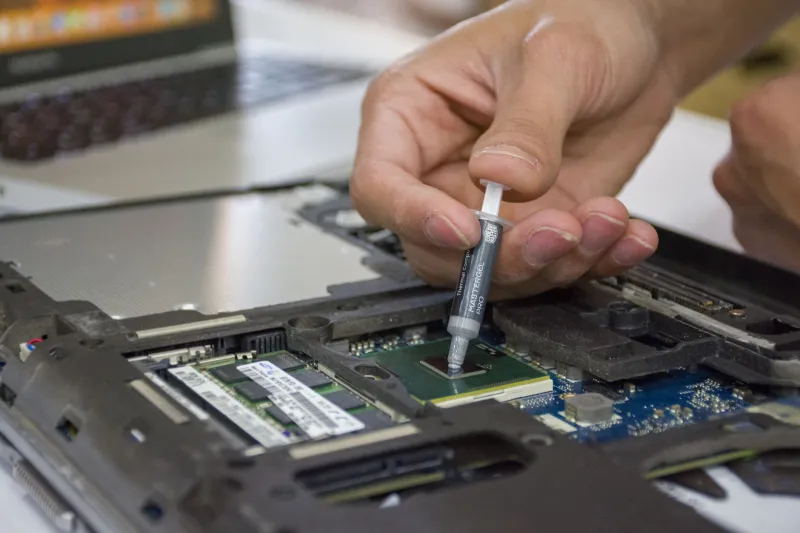
Replacing thermal paste is a more involved intervention that can yield dramatic results on laptops more than two to three years old. Manufacturer-applied thermal compound degrades over time, and repasting with a high-quality compound (Thermal Grizzly Kryonaut is a widely respected option among hardware enthusiasts) can reduce processor temperatures by 10°C to 20°C on aged hardware — enough to meaningfully reduce throttling frequency.
Performance mode settings, available through manufacturer utilities on most current Windows laptops (Dell's Alienware Command Center, Lenovo's Vantage, ASUS's Armoury Crate), adjust fan curves and power limits to prioritize thermal headroom over acoustic comfort. Enabling the highest performance mode before intensive work sessions can sustain higher clock speeds for longer durations.
For smartphones:
Passive smartphone cooling cases — cases incorporating a graphite or copper thermal dissipation layer — offer modest but real temperature reductions during gaming or video recording. Active cooling accessories, including small clip-on fans and Peltier cooler attachments marketed primarily to mobile gamers, can reduce surface temperatures by 5°C to 10°C, which translates to measurably better sustained performance in benchmark testing.
The most practical behavioral adjustment is simply avoiding use cases that compound thermal load: charging while running intensive applications generates substantially more heat than either activity in isolation. Keeping the device at room temperature (not in direct sunlight or a warm car) before intensive sessions also provides a meaningful thermal buffer before throttling begins.
Setting Realistic Expectations
No cooling solution entirely eliminates thermal throttling on devices that were not engineered with adequate sustained performance headroom. The physics are fixed. What these interventions accomplish is extending the window before throttling begins and reducing the severity of the performance reduction when it does occur.
The more fundamental remedy is purchasing decisions informed by sustained performance data rather than burst benchmark scores. Independent hardware publications that test sustained CPU and GPU performance over 30-minute continuous workloads — rather than brief benchmark runs — provide far more predictive insight into real-world behavior than manufacturer specifications alone.
For buyers who regularly run video editing, 3D rendering, software compilation, or other thermally demanding workloads, devices with larger chassis, higher TDP processors paired with appropriate cooling infrastructure, and vapor chamber thermal systems represent a meaningfully better long-term investment than their thinner, lighter competitors — regardless of how similar their spec sheets may appear.