Built to Break Your Budget: How Device Manufacturers Engineer Repairability Out of Their Products
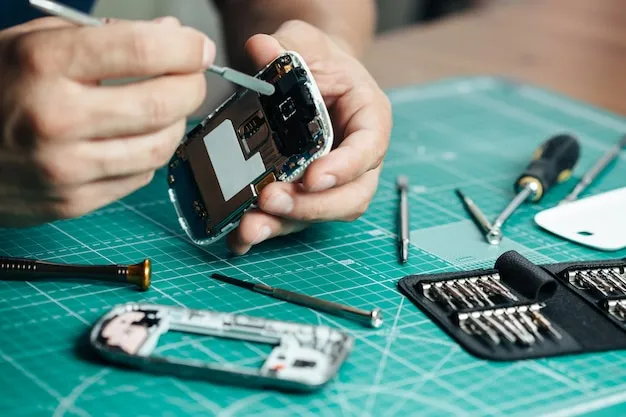
Photo: smartphone repair technician disassembling device with tools on workbench, via img.freepik.com
When the screen on your smartphone shatters or your laptop battery swells past the point of usability, you face a familiar crossroads: pay the manufacturer's authorized repair center, attempt a third-party fix, or simply buy a new device. For millions of American consumers, that choice is far less free than it appears. A growing body of evidence suggests that the difficulty of independent device repair is not accidental—it is, in many cases, deliberately engineered.
The Right to Repair movement has been building momentum for years, and 2025 marks a pivotal chapter in that story. But to understand where the fight stands today, it helps to first understand exactly how manufacturers have constructed the barriers consumers now face.
The Architecture of Obstruction
The obstacles to self-repair are layered and mutually reinforcing. On the physical level, manufacturers have progressively shifted toward proprietary fasteners—specialized screws that require tools unavailable at any standard hardware store. Apple's pentalobe screw, introduced more than a decade ago, became a symbol of this approach, but the practice extends across brands and product categories, from gaming consoles to smart home devices.
Beyond hardware, software locks have emerged as arguably the more insidious barrier. Even when a consumer successfully sources a genuine replacement part—say, a display assembly or a battery—many devices now require a proprietary software handshake to authenticate that component. Apple's "parts pairing" system, which links specific hardware to specific devices at the software level, means that an otherwise functional repair can result in degraded performance or persistent warning messages. Samsung has adopted similar practices across portions of its Galaxy lineup.
Then there is the legal dimension. Manufacturers have historically invoked the Digital Millennium Copyright Act to argue that bypassing software protections on a device—even for repair purposes—constitutes a copyright violation. Independent repair shops have faced cease-and-desist letters, restricted access to service manuals, and deliberate withholding of diagnostic software. For years, John Deere's restrictions on agricultural equipment software made it a flashpoint in the broader debate, underscoring that the issue extends well beyond consumer electronics.
What Repairs Actually Cost
The financial stakes for consumers are substantial. A battery replacement for a current-generation iPhone through Apple's authorized service program runs approximately $99 for most models. Independent repair shops, when they can legally and practically perform the same service, typically charge between $40 and $65 for the same job. For a cracked screen on a flagship Android device, the gap can be even wider—authorized replacements frequently exceed $200, while third-party alternatives often come in under $120.
Over the lifespan of a typical device, these differences compound. A 2024 study by the U.S. Public Interest Research Group estimated that American consumers could save an average of $330 per household annually if independent repair were more freely accessible. Multiply that across tens of millions of households, and the aggregate consumer cost of repair restrictions reaches into the billions of dollars each year.
For lower-income households, the calculus becomes even more consequential. When an authorized repair costs more than half the price of a refurbished replacement device, many consumers simply opt for the latter—generating unnecessary electronic waste and perpetuating a cycle of premature device replacement that benefits manufacturers' bottom lines.
The Regulatory Landscape in 2025
The political response to these concerns has accelerated considerably. As of early 2025, more than 30 U.S. states have introduced or are actively considering Right to Repair legislation. Minnesota and Colorado have enacted laws covering certain categories of consumer electronics, requiring manufacturers to make parts, tools, and documentation available to independent repair providers and consumers on fair and reasonable terms.
At the federal level, the Federal Trade Commission issued a report several years ago concluding that manufacturer restrictions on independent repair harm consumers and competition—and has continued to signal interest in enforcement action. The agency's position has placed additional pressure on manufacturers to soften their stances, at least publicly.
Apple, notably, launched its Self Repair Program in 2022 and has expanded it incrementally since. The program allows consumers to rent genuine Apple tools and purchase official parts for certain repairs. Advocates, however, are quick to point out the limitations: the tool rental process is cumbersome, the pricing on parts remains high, and the program does not extend to all devices or all repair types. Critics characterize it as a strategic concession designed to blunt legislative momentum rather than a genuine commitment to repairability.
Which Device Categories Are the Worst Offenders?
Not all product categories present equal barriers. Repair advocacy organization iFixit publishes repairability scores for consumer electronics, and the results reveal meaningful variation.
Smartphones consistently rank among the most difficult devices to repair independently, with heavily adhesive-bonded assemblies, parts pairing restrictions, and minimal official documentation for third-party technicians. Laptops occupy a middle ground—some manufacturers, including Framework, have built entire product lines around modular repairability, while others, particularly in the ultra-thin segment, use soldered components and proprietary connectors that make even memory or storage upgrades impossible.
Small consumer electronics—wireless earbuds, smartwatches, and compact smart home devices—are frequently considered beyond repair by design. Batteries in these products are often glued directly into housings, and replacement parts are rarely if ever made available. When the battery degrades, the device is effectively disposable.
Printers represent a different kind of obstruction. While physically accessible, many models employ firmware restrictions that prevent the use of third-party ink cartridges, locking consumers into manufacturer-controlled consumables at significant ongoing cost.
What Advocates Are Actually Achieving
Repair advocacy groups are measured but cautiously optimistic about the current trajectory. Nathan Proctor, who leads the Right to Repair campaign at U.S. PIRG, has noted that the legislative wins of recent years represent a meaningful shift in political viability, even if implementation remains uneven. "The conversation has fundamentally changed," Proctor has said in public statements. "Manufacturers are no longer able to simply ignore this issue."
The practical impact of enacted legislation is still being assessed. Early evidence from states with active repair laws suggests that parts availability has improved incrementally for covered device categories, though enforcement mechanisms remain a work in progress.
The European Union's more aggressive regulatory posture—including mandatory repairability ratings and extended manufacturer obligations—has also created indirect pressure on global manufacturers, some of which have begun adjusting product designs to meet European standards in ways that benefit American consumers as well.
The Broader Implication
The Right to Repair debate is, at its core, a question about ownership. When a consumer purchases a device, the degree to which they actually control that device—and can maintain it over time—has direct consequences for their financial wellbeing and for the volume of electronic waste the country generates.
Manufacturers frame their restrictions in terms of safety, quality assurance, and intellectual property protection. These are not entirely fabricated concerns. Poorly performed repairs can create genuine hazards, particularly with lithium-ion batteries. But critics argue that the breadth and systematic nature of current restrictions far exceeds what safety rationale alone could justify.
For consumers navigating this landscape today, the practical advice is straightforward: check iFixit's repairability scores before purchasing a new device, seek out manufacturers with transparent parts and documentation policies, and support state-level Right to Repair legislation where it appears on the ballot or before your representatives. The structural change consumers need will ultimately require both regulatory action and market pressure—and right now, both are available tools.